LIVE EVENT
GCN Investor Conference in Newport Beach, CA
MARCH 25, 2027 · NEWPORT BEACH, CA

LIVE



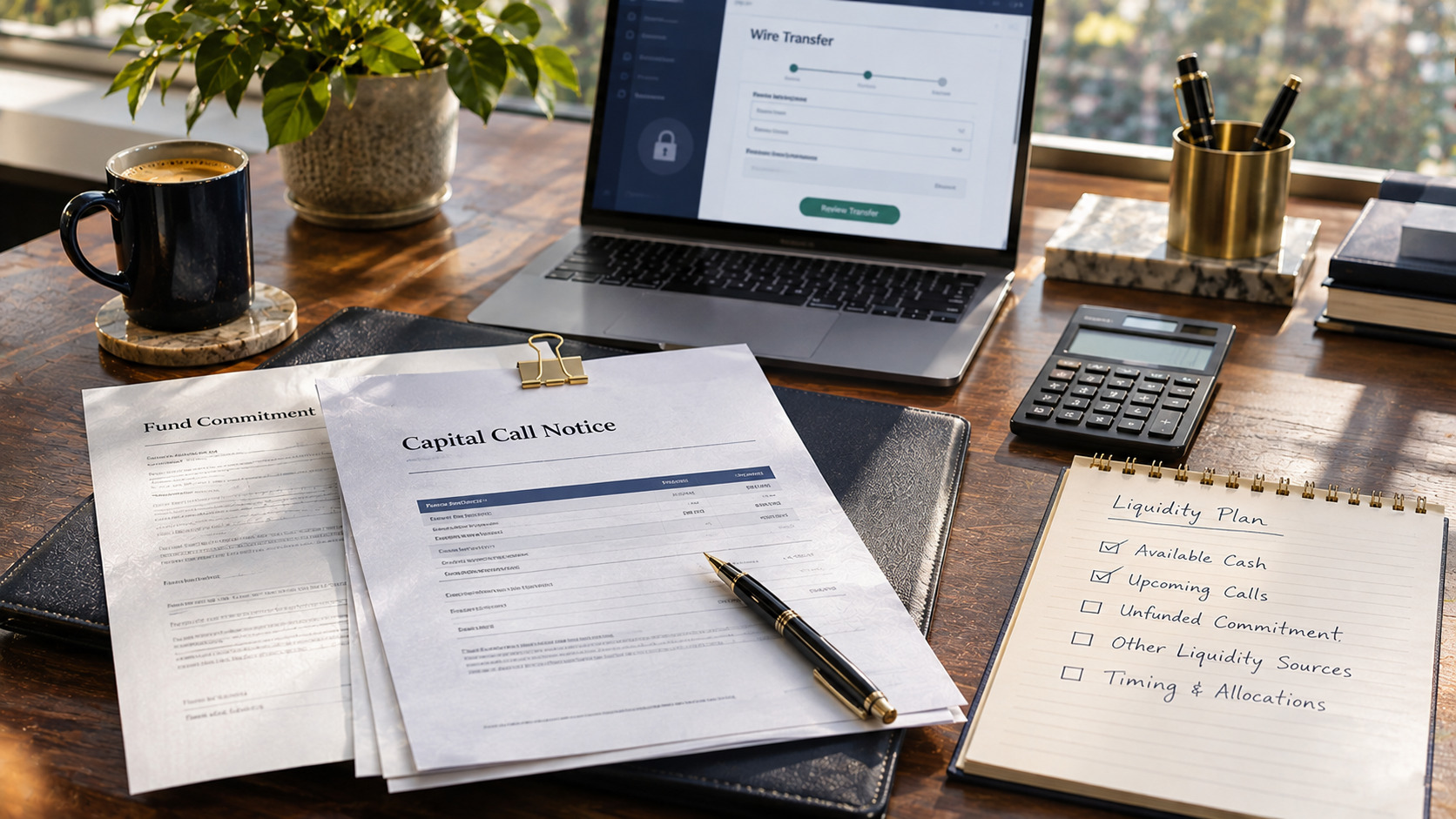


A capital call (also called a drawdown) is a formal request from a fund manager for its investors to wire part of the money they have already committed. It pays for new investments, management fees and fund expenses, and it is a legal obligation under the fund's limited partnership agreement. Investors usually get at least 10 business days' notice, around half of a commitment is typically called within the first two years, and the rest can be called at any time for up to a decade.
This guide explains how capital calls work, what a call notice should contain, how fast funds draw capital, what has changed since 2022, what happens if you cannot pay, and how much cash to keep ready. It is written for new limited partners (LPs) such as family offices, high-net-worth investors and angels moving into funds, and for emerging managers who issue calls. For the wider picture, see becoming an LP.
When you invest in a private equity, venture capital, private credit, real estate or infrastructure fund, you do not send all your money on day one. You sign a commitment, and the general partner (GP) draws it down as it needs cash.
Funds draw capital over time for two reasons. Deals arrive over three to five years, so holding all investors' cash idle would drag on returns. And because IRR is time-weighted, calling money only when it is needed improves the fund's reported return.
Most capital is called during the investment period, usually the first three to six years. After that, in the harvest period, calls are generally limited to follow-on investments in existing companies, fees and expenses. Fund terms are commonly 10 years plus extensions, and venture funds often run longer.
The obligation comes from two documents you sign: the subscription agreement, where you commit a specific amount, and the limited partnership agreement (LPA), which sets the notice period, what calls can be used for, default penalties and recycling rules. Your unfunded commitment is also the collateral for any loan the fund takes against it, which is why lenders care so much about LPs paying on time.
A good capital call notice should show:
The Institutional Limited Partners Association (ILPA) released a new Capital Call and Distribution Template in September 2025 to standardise these notices. It applies to funds launched from 2026 or 2027, depending on whether the manager uses ILPA's other reporting templates.
ILPA's Principles 3.0 call for at least ten business days to respond to a capital call. That is the most common term in US fund documents, but some older or smaller funds allow less, so read your LPA. ILPA also asks managers to give longer notice when a single call is unusually large, roughly 20% to 25% of an LP's unfunded commitment.
Notices usually arrive through an investor portal run by the manager or its fund administrator, with an email alert.
A capital call is a large, expected wire to an account you cannot easily check, which makes it a prime target for email fraud. The FBI's Internet Crime Complaint Center recorded 21,442 business email compromise complaints and $2.77 billion of reported losses in 2024 (IC3 2024 Annual Report). To protect yourself:
There is no fixed schedule. Calls follow deal flow, so they arrive irregularly. Even so, the data shows a clear pattern.
Carta tracks thousands of mostly small venture funds. Its data shows:
So a typical venture LP should expect roughly a quarter of the commitment in year one, about half by the end of year two, and a long tail of follow-on calls after that. Calls to LPs also include fees, so they can run slightly ahead of these deployment figures.
Many funds never call 100%. Pacing studies suggest most buyout and venture funds call somewhere between 85% and 100%, and some credit and real estate funds less. Plan as if all of it will be called, because that is your legal exposure.
The rules have not changed, but the cash flows have. Calls kept coming while distributions dried up.
The lesson for a new LP: do not assume older funds will pay for newer ones on the historical timetable. For more on why cash returned now matters most, see DPI vs TVPI.
Many funds borrow against LPs' unfunded commitments using a subscription line of credit. The fund draws the loan to close a deal quickly, then calls capital weeks or months later to repay it.
For you, a subscription line means fewer but bigger calls. Plan for lumps, not a smooth monthly flow.
Defaulting on a capital call is the outcome to avoid at almost any cost. Typical LPA remedies, which can be combined, include:
Many LPAs also let the manager call extra money from the other LPs to cover a shortfall, usually up to a cap. Defaults are rare, even in 2008 and 2022, mainly because the penalties are so severe. If you see trouble coming, talk to the manager early and look at selling your stake on the secondary market. A voluntary sale near value is almost always better than a forced one at half price.
Recallable amounts are added back to your unfunded commitment. If you spend a recallable distribution, you may have to fund it again. Check the "recallable" line on every distribution notice.
Assume you commit $1,000,000 to a 10-year venture fund with a five-year investment period and a 2% annual management fee on committed capital ($20,000 a year). Investment calls follow a pattern similar to Carta's recent vintages, and 3% of the commitment is never called. These are illustrative assumptions, not a forecast.
Over the fund's life, $770,000 goes into investments and $200,000 into fees, so fees are about 21% of everything called. In the later years, most of each call is fees. That is why fee step-downs and recycling terms matter, as explained in how VC funds make money.
Institutions use pacing models and often commit more than their target allocation, because funds call slowly and return capital before calling it all. That works for large, diversified programmes; individuals and smaller family offices should be more conservative.
Red flags: notice periods shorter than 10 business days, no limits or disclosure on subscription lines, uncapped recycling with long recall windows, total forfeiture as the first remedy with no cure period, and wire instruction changes sent by email.
In the US, the SEC's 2023 private fund adviser rules, which would have required standard quarterly statements, were struck down by the Fifth Circuit in June 2024 (Morgan Lewis). Capital call terms and reporting are therefore set by the LPA, side letters and ILPA templates rather than by regulation. US LPs receive Schedule K-1 tax forms, which often arrive late, so plan on filing extensions. Tax treatment of management fees varies, so take advice.
In the UK and Europe, calls are usually called drawdowns, and unfunded commitments are called undrawn commitments. The mechanics are the same. Semi-liquid vehicles such as ELTIFs and the UK's Long-Term Asset Fund usually take capital upfront instead of calling it.
A formal request from a fund manager for investors to wire part of the money they committed, to pay for investments, management fees or fund expenses. It is a legal obligation under the fund's partnership agreement.
Usually at least 10 business days, which is ILPA's standard. Some fund agreements allow less, and ILPA asks for longer notice when a call is unusually large.
After a short cure period, the manager can charge penalty interest, suspend your rights and distributions, force a sale of your stake at a large discount, cut or forfeit your capital account, and sue for what you owe. Contact the manager early and consider a secondary sale.
Irregularly, whenever the fund needs cash. Expect several calls a year during the investment period, then smaller and rarer calls later. Funds with subscription lines call less often but in bigger amounts.
Neither on its own. Calls during the investment period mean the manager is investing as planned. Watch for calls much faster or slower than projected, or frequent calls for expenses rather than investments.
Usually yes. Fees and fund expenses are paid by calling capital, and the notice should split the amount between investments, fees and expenses. In a typical 10-year fund with a 2% fee, fees can total about 20% of commitments.
The part of your commitment the fund has not called yet. It can be called at any time, subject to the notice period and the fund's terms, and recallable distributions can add to it.
A fund commitment is a promise to pay on demand for up to a decade. Expect at least 10 business days' notice, roughly half your commitment to be called within two years, and calls to keep coming even when distributions do not. Keep the next one to two years of calls in cash, the rest liquid, verify every set of wire instructions, and never let a call go unpaid. The penalties are severe.
Global Capital Network connects LPs, family offices and fund managers through our investor conferences and private investor dinners. Explore our glossary or get in touch to learn more.
This article is general information, not investment, legal or tax advice. Fund terms vary, so read your limited partnership agreement and take advice before committing.


Angel investors, VCs and family offices in one room for one day, with live pitches, exhibitor booths and an evening reception at the Renaissance Newport Beach.
See the event →