European vs American Distribution Waterfall (With Worked Examples)
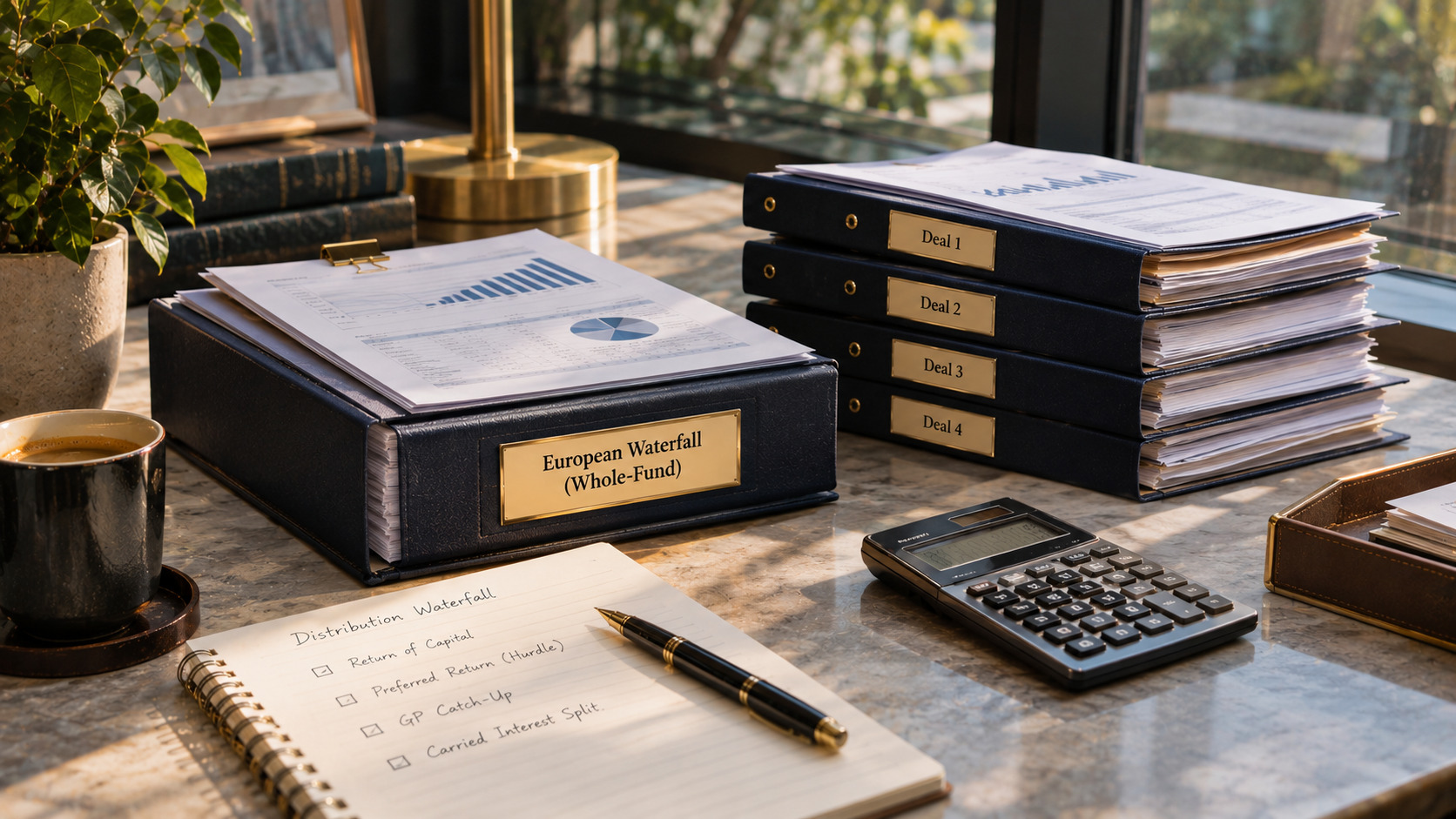
A distribution waterfall is the part of a fund's limited partnership agreement that sets the order in which money is paid out to investors (LPs) and the fund manager (GP). A European, or whole-fund, waterfall pays LPs back all their contributed capital plus a preferred return before the GP earns any carried interest. An American, or deal-by-deal, waterfall pays the GP carry on each profitable exit as it happens and relies on a clawback to fix any overpayment later. If the clawback works, both end with the same total carry. The difference is when the GP gets paid, and who carries the risk until then.
Our guide to how VC funds make money covers fees and carry at a high level. This article goes further, with step-by-step examples on one fund, current market data, and a checklist of what LPs should negotiate.
1. The Four Tiers of a Waterfall
Most waterfalls have four tiers. Each must be filled before money moves to the next.
- Return of capital: 100% to LPs until they get back their contributed capital. In a European waterfall this usually includes management fees and fund expenses, not just the money invested.
- Preferred return (hurdle): 100% to LPs until they have earned a set return on that capital, usually 8% a year compounded, which works like an 8% IRR test.
- GP catch-up: the GP receives most or all of the next distributions until it has its full carry share of profits so far. With 20% carry and a 100% catch-up, the catch-up equals 25% of the preferred return paid.
- Carried interest split: everything after that is split, usually 80% to LPs and 20% to the GP. Some funds step the GP's share up to 25% or 30% above set return levels.
Soft vs hard hurdle
- Soft hurdle: a preferred return with a catch-up. Once LPs clear the hurdle, the GP catches up and ends with 20% of all profits. This is the market norm.
- Hard hurdle: no catch-up. The GP only earns carry on profits above the hurdle. ILPA, the main LP association, prefers this, but it is uncommon.
For how the preferred return itself is calculated and negotiated, including compounding, accrual start dates and fees, see hurdle rate and preferred return.
2. European, American and Hybrid Waterfalls
European (whole-fund)
- Every distribution, from any deal, goes to LPs until they have recovered all capital contributed to date, including fees and expenses, plus the preferred return.
- The test covers the whole portfolio: realised, unrealised and written-off deals.
- The GP is usually paid late, often in years 6 to 10.
- Used by most European buyout funds and most venture funds worldwide. ILPA Principles 3.0 call it best practice.
American (deal-by-deal)
- When a deal is sold, LPs get back the capital in that deal plus a preferred return on it. The catch-up and 80/20 split then apply to that deal's profit.
- Pure deal-by-deal: ignores losses on other deals. The most GP-friendly form, and rare in institutional funds today.
- Modified deal-by-deal (loss carryforward): before any carry, LPs also recover the cost of earlier realised deals, write-offs and write-downs, and fees and expenses.
- Fair value or NAV tests: carry is paid only if the rest of the portfolio is worth more than a cushion, often 110% to 125% of the capital still invested.
- Used by most US buyout funds, and common in real estate and some credit funds.
Hybrids
- European with interim carry: carry starts once realised proceeds cover a set share of contributions plus a value cushion.
- Deal-by-deal with escrow: part of each carry payment is held back to cover a future clawback. ILPA suggests at least 30%.
- Fee and carry choices: some funds let LPs choose, for example a 2% fee with 20% carry or a 1% fee with 30% carry.
3. What the Market Uses in 2026
- North American buyout: 64% use deal-by-deal and 36% whole-fund; 89% use an 8% preferred return (Proskauer, June 2026).
- European buyout: 85% use whole-fund and 12% a hybrid (same Proskauer reports).
- Large US buyout funds: in Paul Weiss's April 2024 survey of funds targeting $2.5 billion or more, 88% used deal-by-deal, and 72% had no carry escrow.
- US venture capital: 80% use a European waterfall and 90% have no preferred return. About 62% raise carry to 25% or 30% above set performance levels (Proskauer, November 2026).
- Hurdles in VC: Carta found hurdles in only 12.4% of venture funds over $100 million (Carta Fund Economics Report 2025).
- Catch-up: a 100% catch-up is standard in private equity, while real estate funds mostly use 50%, according to Goodwin's 2023 and 2024 fund terms data. Credit funds mostly use hurdles of 5% to 7%.
These surveys cover different fund sizes and strategies, so the percentages differ. The consistent pattern: the bigger and more established the US buyout manager, the more likely it uses deal-by-deal.
4. Worked Examples: One Fund, Two Waterfalls
Assumptions: a $100 million fund calls all its capital at the start and invests $25 million in each of four deals. Fees are ignored for now (section 6 adds them). Terms are an 8% preferred return compounded annually, a 100% catch-up and 80/20 carry.
- Deal A: sold at the end of year 3 for $75 million (profit $50 million).
- Deal D: written off in year 4 (loss $25 million).
- Deal B: sold at the end of year 5 for $10 million (loss $15 million).
- Deal C: sold at the end of year 6 for $80 million (profit $55 million).
- Fund total: $165 million back on $100 million, a profit of $65 million. The GP's fair share at 20% is $13.0 million.
Example A: European waterfall
LPs must get back $100 million plus 8% a year before any carry. We track an "LP hurdle balance" that grows by 8% a year and falls with each payment to LPs.
- Year 3, Deal A ($75 million): all to LPs as return of capital. Balance: $100M × 1.08³ = $125.971M, less $75M = $50.971M.
- Year 4: no distribution. Balance grows to $55.049M.
- Year 5, Deal B ($10 million): all to LPs. Balance: $59.453M less $10M = $49.453M.
- Year 6, Deal C ($80 million): the balance has grown to $53.409M.
- Return of remaining capital: $15.000M to LPs
- Preferred return: $53.409M − $15.000M = $38.409M to LPs
- GP catch-up: 25% of $38.409M = $9.602M to the GP
- Remaining $16.989M split 80/20: $13.591M to LPs and $3.398M to the GP
- Result: LPs receive $152.0M. The GP receives $9.602M + $3.398M = $13.0M, exactly 20% of profits, all in year 6. No clawback is needed.
Example B: Pure deal-by-deal waterfall
Each sale runs through its own waterfall, using only that deal's $25 million and its own preferred return.
- Year 3, Deal A ($75 million): $25M capital back; preferred return 25 × (1.08³ − 1) = $6.493M; catch-up $1.623M; remaining $41.884M split 80/20. GP gets $10.0M.
- Year 5, Deal B ($10 million): a loss, so all $10M goes to LPs. GP gets nothing.
- Year 6, Deal C ($80 million): $25M back; preferred return 25 × (1.08⁶ − 1) = $14.672M; catch-up $3.668M; remaining $36.660M split 80/20. GP gets $11.0M.
- Result: the GP has received $21.0M against a fair share of $13.0M. It has been overpaid by $8.0M, which it owes back under the clawback.
If the clawback is repaid in full, LPs end with $152.0M, the same as the European waterfall. But most fund agreements cap the clawback at the carry the GP kept after tax. If we assume a 30% tax rate, purely for illustration, the GP repays only $5.6M. LPs end with $149.6M and the GP keeps $15.4M, or 23.7% of profits instead of 20%.
Example C: Deal-by-deal with loss carryforward
Before carry on any sale, LPs must recover the cost and preferred return on every deal already sold or written off.
- Year 3, Deal A: Deal D has not been written off yet, so this works like Example B. GP gets $10.0M.
- Year 5, Deal B: LPs are now below the hurdle across A, B and D, so all $10M goes to LPs.
- Year 6, Deal C: all deals are now sold, so the test matches the whole-fund test. The GP is entitled to $13.0M in total and already has $10.0M, so it gets $3.0M. LPs get $77.0M.
- Result: LPs $152.0M, GP $13.0M, with no clawback needed.
Timing of write-downs matters. If Deal D had been written down before Deal A was sold, the GP would have received only $5.0M in year 3 and $8.0M in year 6. Prompt write-down rules protect LPs.
Example D: A weaker fund
Now assume Deal C sells for $50 million instead of $80 million. The fund returns $135 million, a profit of $35 million, but LPs earn less than 8% a year.
- European, 8% hurdle: the GP earns no carry. The LP hurdle balance of $53.4M in year 6 is more than the $50M available.
- Pure deal-by-deal: the GP has already taken $10.0M in year 3 and takes another $5.0M from Deal C. It owes back $15.0M, or only $10.5M if the clawback is capped after a 30% tax.
- Deal-by-deal with loss carryforward: the GP took $10.0M in year 3 and owes it all back.
- European with no hurdle (typical in venture): the GP earns 20% of the $35M profit, $7.0M, in year 6.
This is where waterfall design matters most. A deal-by-deal waterfall can pay $15 million of carry on a fund that owes the GP nothing, leaving LPs to chase the money back.
Example E: Timing and LP returns
In the base case, both waterfalls pay the GP $13.0M in the end, but the timing differs:
- Fund before carry: about 11.9% IRR.
- European: LPs earn about 10.1% IRR. The GP's $13.0M arrives in year 6.
- Deal-by-deal with full clawback, or with loss carryforward: LPs earn about 9.6% IRR. The GP receives $10.0M in year 3 and $3.0M in year 6.
- Pure deal-by-deal with a tax-capped clawback repaid in year 8: LPs earn about 9.2% IRR.
Moving $10 million of carry three years earlier costs LPs about half a percentage point of IRR on identical dollar totals, and raises the present value of the GP's carry by about 20%.
5. How the Hurdle and Catch-Up Change Carry
Take $100 million invested for one year with an 8% preferred return and 20% carry. GP carry at different total payouts:
- $105 million (a 5% return): no hurdle $1.0M; soft hurdle with 100% catch-up $0; soft hurdle with 50% catch-up $0; hard hurdle $0.
- $110 million (10%): no hurdle $2.0M; 100% catch-up $2.0M; 50% catch-up $1.0M; hard hurdle $0.4M.
- $115 million (15%): no hurdle $3.0M; 100% catch-up $3.0M; 50% catch-up $3.0M; hard hurdle $1.4M.
- $130 million (30%): no hurdle $6.0M; 100% catch-up $6.0M; 50% catch-up $6.0M; hard hurdle $4.4M.
A hurdle with a full catch-up only protects LPs in mediocre outcomes. A 50% catch-up widens that range. Only a hard hurdle cuts carry in good outcomes. And once returns are strong, a venture fund with no hurdle pays the same carry as a buyout fund with one. That is why most venture funds skip the hurdle.
6. Fees, the GP Commitment and Tax Distributions
- Are fees returned before carry? In a European waterfall, usually yes. Add $15 million of lifetime fees to our example, so LPs contribute $115 million. If fees are returned first, carry is 20% of $50M = $10.0M. If only invested capital is returned first, carry is 20% of $65M = $13.0M. That $3.0M difference is worth negotiating.
- Deal-by-deal funds often return only the fees allocated to the deal being sold. ILPA asks for all fees and expenses to be returned first.
- GP commitment: the GP's own money in the fund normally pays no fees or carry. Carta reports a median GP commitment of 1.7% in venture and 2.55% in private equity.
- Tax distributions: many US funds let the GP take cash to pay tax on carry income before it is distributed. These are advances against carry, and they add to overpayment risk.
7. The Clawback
A clawback requires the GP to return carry it received above its agreed share of the fund's total profits. It matters far more in deal-by-deal funds, where carry is paid before later losses are known. The best protection is a whole-fund waterfall. For deal-by-deal funds, ILPA recommends:
- holding back at least 30% of carry in escrow
- yearly interim clawback tests, for example whenever remaining value falls below 125% of unreturned capital
- a clawback calculated before tax where possible, repaid within two years
- guarantees from the individuals or parent company receiving carry
In practice, protections are often weaker. In Paul Weiss's 2024 survey of large US buyout funds, 72% had no escrow and clawbacks were generally capped at the after-tax amount. Large managers disclose big figures: Blackstone's 2024 annual report put the carry that could be clawed back, if every carry fund investment were worthless, at $7.3 billion after tax. Our separate guide to GP clawback provisions covers how the clawback is calculated, secured and negotiated in more detail.
8. Recent Trends
- The regional split continues: US buyout stays mostly deal-by-deal, while Europe stays whole-fund with more hybrids.
- Continuation funds: when a manager moves assets into a new vehicle, carry can be locked in early. ILPA's October 2026 guidance asks for no carry to be crystallised for LPs who roll over, and for a meaningful part of any crystallised carry to be reinvested.
- NAV loans: distributions funded by borrowing against the portfolio, rather than real exits, can push a fund through the return-of-capital tier. Check whether carry can be paid on borrowed money.
- Better reporting: ILPA's 2025 reporting templates separate accrued carry from carry actually earned, making waterfalls easier to check.
9. LP Checklist: What to Check and Negotiate
- Waterfall type: whole-fund, deal-by-deal or hybrid. If deal-by-deal, are losses and write-downs carried forward?
- Contributed capital: are all fees and expenses returned before carry?
- Preferred return: the rate, whether it compounds, and whether it starts when capital is at risk, including subscription line draws.
- Catch-up: 100%, 80% or 50%.
- Carry rate: any step-ups, and whether they are tested on net or gross returns.
- Clawback: interim tests, before or after tax, escrow percentage, and guarantees.
- Tax distributions: treated as carry advances and covered by the clawback.
- Unrealised gains: no carry on paper gains, in-kind distributions or borrowing-funded payouts until capital is returned.
- Recycling: capped, and counted properly for the preferred return.
- Continuation funds: an option to keep your stake without carry being crystallised.
- Transparency: a waterfall model at signing and ILPA-standard reporting.
For other terms to review before committing, see becoming an LP, key-person clauses and side letters. For why cash returned matters most when judging a fund, see DPI vs TVPI.
10. UK and Europe
Whole-fund waterfalls are standard in European buyout and venture funds, and European LPs generally expect a manager to justify deal-by-deal terms. In the UK, carried interest has been taxed as trading income from April 2026, with qualifying carry taxed at an effective top rate of about 34%. For waterfall design, this mainly affects holding-period rules and how after-tax clawback caps are worked out for UK carry holders.
Frequently Asked Questions
What is a distribution waterfall?
The rules in a fund's partnership agreement that set the order in which cash is paid out. Typically: LP capital back, then a preferred return of about 8%, then a GP catch-up, then an 80/20 split of remaining profits.
What is the difference between a European and an American waterfall?
A European waterfall returns all contributed capital and the preferred return across the whole fund before the GP earns carry. An American waterfall pays carry on each profitable sale once that deal's capital and preferred return are back, and relies on a clawback to fix overpayments.
Which waterfall is better for LPs?
The European waterfall. It removes most clawback risk and delays GP pay until LPs are whole. In our example it raised LP IRR from about 9.6% to about 10.1% on the same dollar totals.
What is a GP catch-up?
A tier after the preferred return where the GP receives most or all of the distributions until it has its full carry share of profits so far. With 20% carry and a 100% catch-up, it equals 25% of the preferred return paid.
What is a hurdle rate in a waterfall?
The minimum return, usually 8% a year in private equity, that LPs must receive before the GP earns carry. With a catch-up it mostly affects timing; without one it permanently reduces carry.
Do VC funds have a preferred return?
Usually not. Proskauer's 2026 data show 90% of US venture funds have no preferred return, and Carta found hurdles in only 12.4% of venture funds over $100 million.
What is a clawback in private equity?
An obligation on the GP to return carry above its agreed share of the fund's total profits, usually tested at the end of the fund and sometimes along the way. It is often capped at after-tax carry and backed by escrow or guarantees.
The Bottom Line
European and American waterfalls can pay the GP the same carry in the end. What changes is timing and risk. A European waterfall makes LPs whole first; a deal-by-deal waterfall pays the GP early and depends on a clawback that is often capped after tax and rarely backed by escrow. If you accept deal-by-deal, insist on loss carryforward, the return of all fees, escrow, interim clawback tests and guarantees, and always ask the manager to model the waterfall for you before you sign.
Global Capital Network connects LPs, family offices and fund managers through our investor conferences and private investor dinners. Explore our glossary or get in touch to learn more.
This article is general information, not investment, legal or tax advice. The examples are illustrative and use simplified assumptions; real fund agreements differ. Read your limited partnership agreement and take advice before committing.