Quantum Computing Investing: Separating Roadmaps from Reality
Quantum computing promises to solve problems that are practically impossible for today's computers, from simulating molecules for drug discovery to optimising complex systems. Large technology companies, governments and venture investors have poured billions into the field, and several quantum companies have gone public.
But the gap between today's machines and commercially transformative quantum computers remains large. Company roadmaps are ambitious, and share prices of listed quantum companies have swung sharply. This guide explains where the technology really stands, the main approaches, and how investors can separate credible progress from promotion.
1. Where the Technology Stands
- Today's machines are noisy. Current quantum computers make frequent errors, which limits the size and reliability of calculations.
- Error correction is the key milestone. Useful large-scale quantum computing depends on combining many physical qubits into more reliable "logical" qubits. In December 2024, Google reported results with its Willow chip showing errors falling as the system scaled, an important step.
- Roadmaps point to the end of the decade. Major players have published plans targeting fault-tolerant systems around the late 2020s and early 2030s, though timelines remain uncertain.
- Commercial advantage is still limited. Clear, repeatable cases where quantum computers beat classical computers on valuable real-world problems remain rare.
2. The Main Approaches
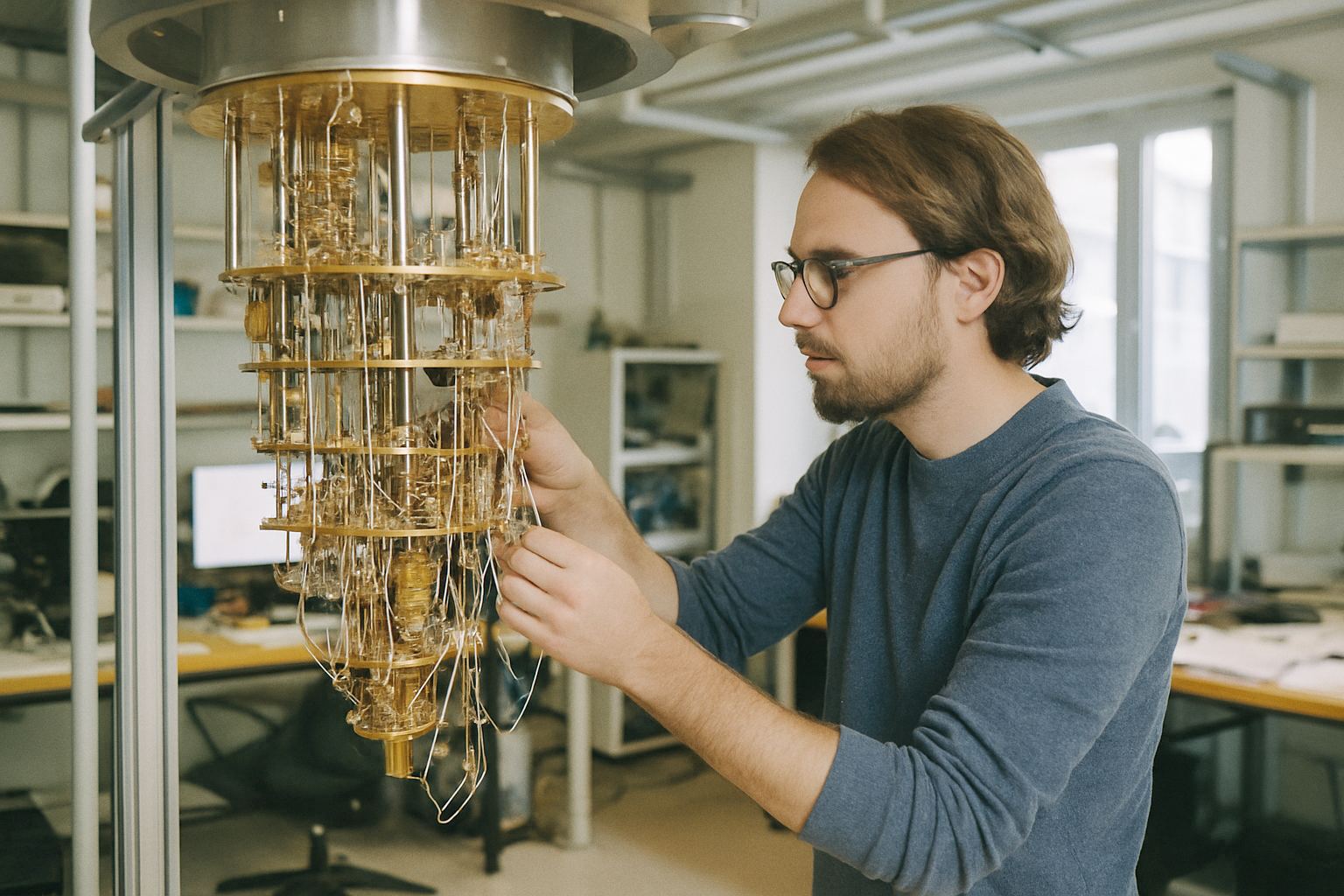
- Superconducting qubits, used by Google, IBM and Rigetti, among others. Fast operations but require extreme cooling.
- Trapped ions, used by IonQ and Quantinuum. High accuracy, with challenges in speed and scaling.
- Neutral atoms, a fast-growing approach offering potential for large numbers of qubits.
- Photonics, using particles of light, with potential advantages in networking and room-temperature operation.
- Topological qubits, pursued by Microsoft, which aim for built-in error resistance but remain early and debated.
No approach has yet clearly won, so investors are effectively betting on different engineering paths.
3. Where Nearer-Term Value Lies
- Post-quantum cryptography. The US National Institute of Standards and Technology finalised its first post-quantum encryption standards in 2024, creating demand for security products that protect against future quantum attacks.
- Quantum sensing for navigation, medical imaging and resource exploration, which can be commercially useful before full-scale computing arrives.
- Software and tools that help developers build and test quantum applications across different hardware.
- Components and supply chain, such as cryogenics, lasers and control electronics, which serve many hardware companies.
4. Lessons From Public Markets
Several quantum companies, including IonQ, Rigetti and D-Wave, went public through SPACs in 2021 and 2022. Their share prices have been extremely volatile, with large swings driven by technical announcements, market sentiment and interest in AI and advanced computing. For investors, the lesson is to separate technical milestones from market enthusiasm. See our analysis of the SPAC cycle.
5. How to Diligence a Quantum Company
- Independent technical review. Have experts assess claims about qubit counts, error rates and performance.
- Focus on error rates, not just qubit counts. More qubits matter little if errors are too high to use them.
- Map the roadmap to capital. How much funding is needed to reach each milestone, and from whom?
- Look for revenue that does not depend on full-scale quantum, such as sensing, software, services or government contracts.
- Check government support. Grants and national programmes can extend runway. See grants and government programmes.
For related deep-tech investing, see how deep tech startups get funded.
Frequently Asked Questions
When will quantum computers be commercially useful?
Some niche uses exist today, but broadly transformative applications likely depend on fault-tolerant machines that major players target for the late 2020s or 2030s.
Is qubit count the best measure of progress?
No. Error rates, connectivity and the ability to run useful algorithms matter more than raw qubit numbers.
What is post-quantum cryptography?
Encryption designed to resist attacks from future quantum computers. Organisations are beginning to adopt it now, creating near-term commercial demand.
Should investors buy listed quantum stocks?
They can, but should expect high volatility and base decisions on technical progress and financial runway rather than headlines.
The Bottom Line
Quantum computing is progressing, and error correction milestones are real. But commercial transformation remains years away, and roadmaps should be treated as goals rather than guarantees. Investors who focus on error rates, independent technical review, capital plans and nearer-term revenue in sensing, software and security can participate without betting everything on the most optimistic timelines.
Global Capital Network connects deep-tech founders with investors through our events and investor network. Get in touch to learn more.
This article is general information, not investment advice.






.png)


.webp)
.png)


.png)